


On January 13, 2026, Variety declared Zoe Saldaña “the highest-grossing actor of all time”. Her films have now amassed $15.47 billion at the global box office - more than Scarlett Johansson, Samuel L. Jackson, or Robert Downey Jr. It’s a staggering figure. But it’s also misleading.

Saldaña appeared in Avatar, Avengers: Endgame, and Infinity War, but so did ninety-one other actors, from Chris Pratt’s Star-Lord to David Thewlis’s Peylak. How much of that $15.47 billion is actually hers?
When you weight box office by screen time - crediting actors only for the minutes they’re actually on screen - Saldaña’s figure shrinks to $3.97 billion. That’s not first place. It’s at most fourth, behind Tom Cruise, Chris Pratt, and Robert Downey Jr.
The “Lead Role” Fix (And Why It’s Still Broken)
Industry trackers recognized this problem years ago. The Numbers, which Variety and others cite for these rankings, doesn’t count every film an actor has appeared in - only those where they have a “lead or lead ensemble” role. This filters out true cameos and bit parts. But it’s also why Robert Downey Jr.’s Oscar-winning turn in Oppenheimer ($976M) doesn’t count toward his total: it’s classified as supporting.
But “lead or lead ensemble” is a categorical fix for a continuous problem. Consider what it includes:
Saldaña receives full credit for Avengers: Endgame‘s $2.8 billion. But her Gamora, a time-displaced variant of a character who died in the previous film, appears for less than five minutes of a three hour-plus runtime. Downey’s Tony Stark appears in over an hour of footage, memorably anchoring the emotional climax of the film. Both get the same $2.8 billion added to their tally.
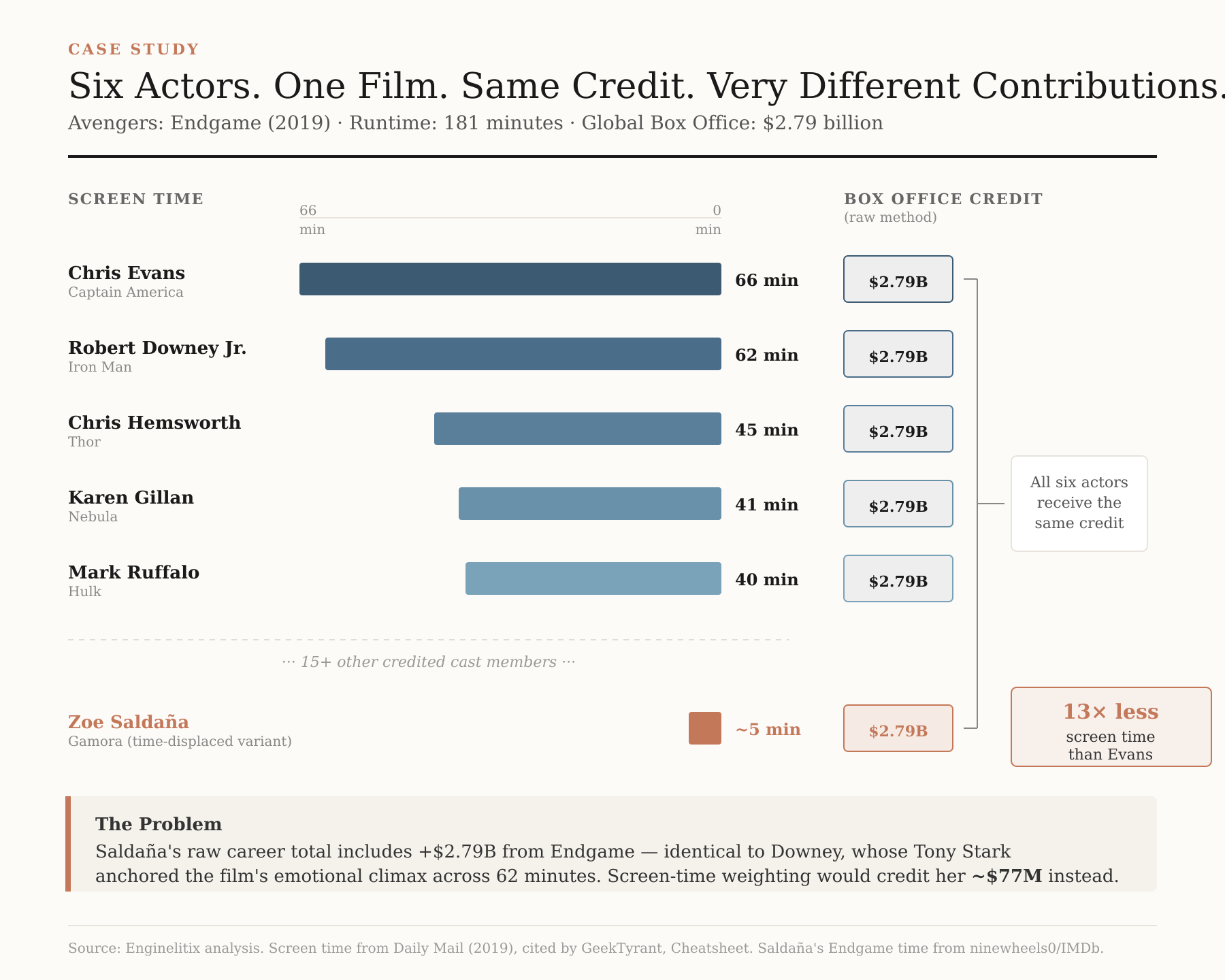
The deeper issue is that the “lead” designation treats screen presence as a binary label when it should be a numerical value.
Consider The Fellowship of the Ring where Ian McKellen’s Gandalf was labelled a supporting actor role by the studio despite being on screen for a hefty 46 minutes, a mere fifteen seconds less than Elijah Wood’s Frodo, the stated lead. It’s speculated this was strategic so McKellen could be nominated for the Best Supporting Actor role. Or Daniel Radcliffe, who’s the lead of every Harry Potter film, but his screen time ranges from 48 minutes (Deathly Hallows Part 2) to nearly twice that at 83 minutes (Chamber of Secrets). Emma Watson is also a designated lead in all eight films, but she logged 205 minutes total to Radcliffe’s 539.
If we’re trying to measure how much box office an actor actually generated, counting only lead roles gets us partially there. But we contend with inconsistencies in the “lead” labeling by different parties, whether it’s a metrics website like The Numbers or movie studios. It still treats a five-minute “lead ensemble” appearance the same as carrying a film for over an hour. We need something more granular.
Screen Presence, Literally: A Screen-Time-Weighted Approach
The concept is simple: instead of giving an actor 100% credit for a film’s box office, give them credit proportional to their screen presence. If you’re on screen for 30% of a film that grossed $1 billion, your weighted contribution is $300 million.
Apart from curated subsets like Oscar nominees, there’s no industry-wide dataset of actor screen time. Creating one means pointing computer vision models at a lot of movies, which, if any studio is curious, is very much our thing at Enginelitix. To estimate screen time where it isn’t publicly available, we built a quick prediction model using about five hundred data movie roles from available screen time data: primarily Oscar-nominated performances tracked by Screen Time Central and MCU ensemble data from fan trackers. The model predicts screen time percentage based on billing position, cast size, and runtime.
Weighting by screen presence also means we don’t need a “lead” label to decide whether a role is important, allowing us to accommodate more of an actor’s filmography - like Oppenheimer for Downey Jr. The model isn’t perfect. It performs best when predicting supporting-role screen-times and for ensemble movies, where it’s typically off by 5 percentage points: For Robert Downey Jr in Iron Man 3 it predicted 45.9% screen time against the actual 47.7%. That’s reassuringly close. But the model was trained on Oscar dramas and MCU ensembles, not action blockbusters. For actors like Tom Cruise, whose filmography is dominated by action films absent from the training data, predictions carry more uncertainty (action movies aren’t typically nominated for Oscars, otherwise we can all agree that the 1985 Arnold Schwarzenegger classic Commando would have carried the Best Picture award that year).
I’ve assigned confidence tiers accordingly:
High confidence: Verified screen time data, or actor profile closely matches training data
Medium confidence: Partial verification, some estimation from model
Low confidence: No verified data, significant estimation required
Star-Lord, Who? The Rankings, Reweighted
For each actor we considered all lead or lead ensemble roles and additionally, supporting roles in fiscally impactful movies, typically those grossing at least nine figures. For Samuel L Jackson, for instance, there were over twenty such additional movies. Here’s how eight major stars stack up when box office is weighted by screen presence:
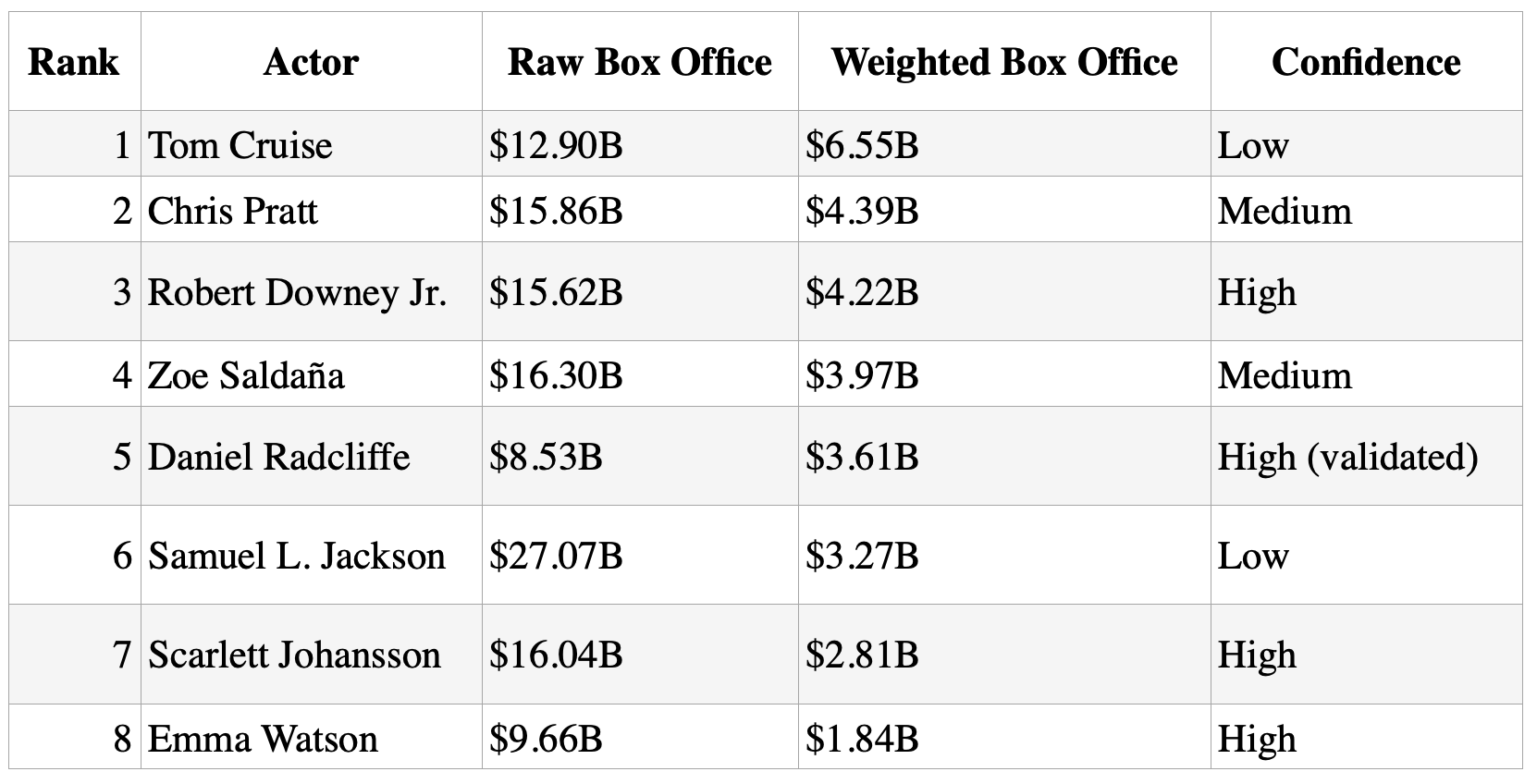
The reshuffling is dramatic. Saldaña drops from first (lead and lead ensemble only) to fourth. Johansson, who briefly held the “highest-grossing” title before Avatar: Fire and Ash, falls to seventh. Tom Cruise who serves as our “always the star” control case, finishes first, validating the methodology: when you’re first-billed in virtually every film and rarely appear in ensembles, screen-time weighting rewards you handsomely. The more interesting question is who wins among actors with mixed portfolios—leads in some films, ensemble players in others. Chris Pratt, who doesn’t appear on most “highest-grossing” lists, rises to the top with $ 4.39 billion, boosted by unequivocally lead roles in both the Jurassic World and Guardians franchises. Somewhere, Peter Quill is thrilled someone finally knows who he is.
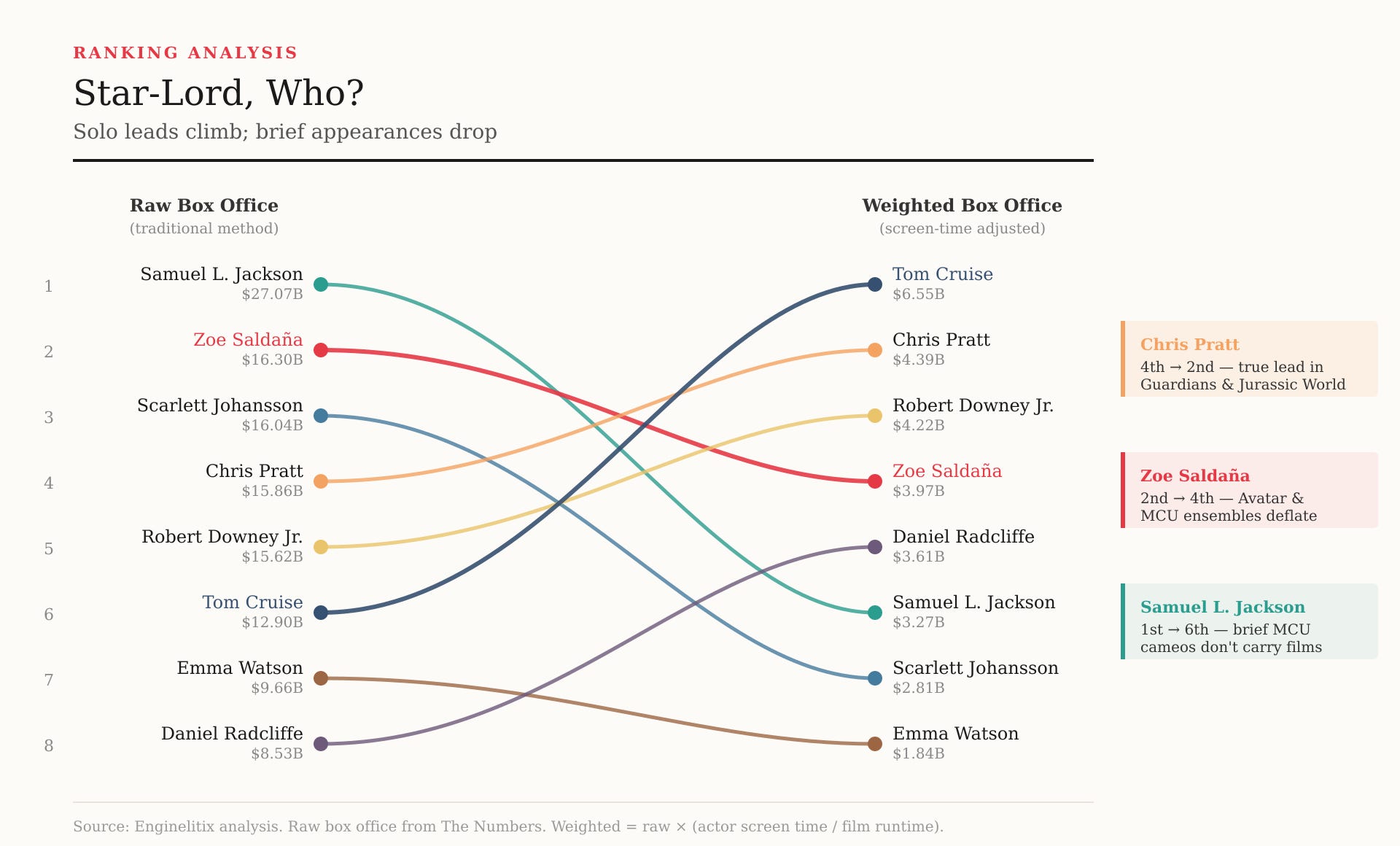
The biggest mover is Samuel L. Jackson. His raw box office of $27.07 billion (he held the Guinness World Record for highest-grossing actor from 2011 until recently) collapses to $3.27 billion when weighted by screen time. The culprit: Jackson’s MCU appearances are largely cameos. He’s guaranteed $4-6 million per appearance as Nick Fury even for a 30-second post-credits scene: lucrative; but hardly carrying the film.
The Boy Who Lived (On Screen the Most)
The Harry Potter franchise offers useful validation. We have verified screen time for the three leads, and the weighted analysis reveals how misleading the raw box office metric can be.
The eight films grossed $7.77 billion combined. Under raw box office accounting, Radcliffe, Watson, and Rupert Grint each get credit for that full amount. But their actual screen presence varied enormously:

Watson’s weighted Harry Potter contribution is just 39% of Radcliffe’s, despite the same “lead” designation in all eight films.
Watson’s raw box office numbers, boosted by Beauty and the Beast’s $1.26 billion, actually beat Radcliffe’s $8.53 billion by over a billion dollars. But her total weighted box office, including Beauty and the Beast and supporting roles in films like The Tale of Despereaux and Noah, tells a different tale. She clocks $1.84 billion; highly respectable, but a far cry from the $9.66 billion her filmography’s raw box office suggests.
Show Me the Money: Who’s Actually Cashing In?
If screen-time-weighted box office is a better measure of “value generated”, how does it compare to the value actors capture for themselves? Absent good data on direct earnings, I’ve taken net worth as a proxy.
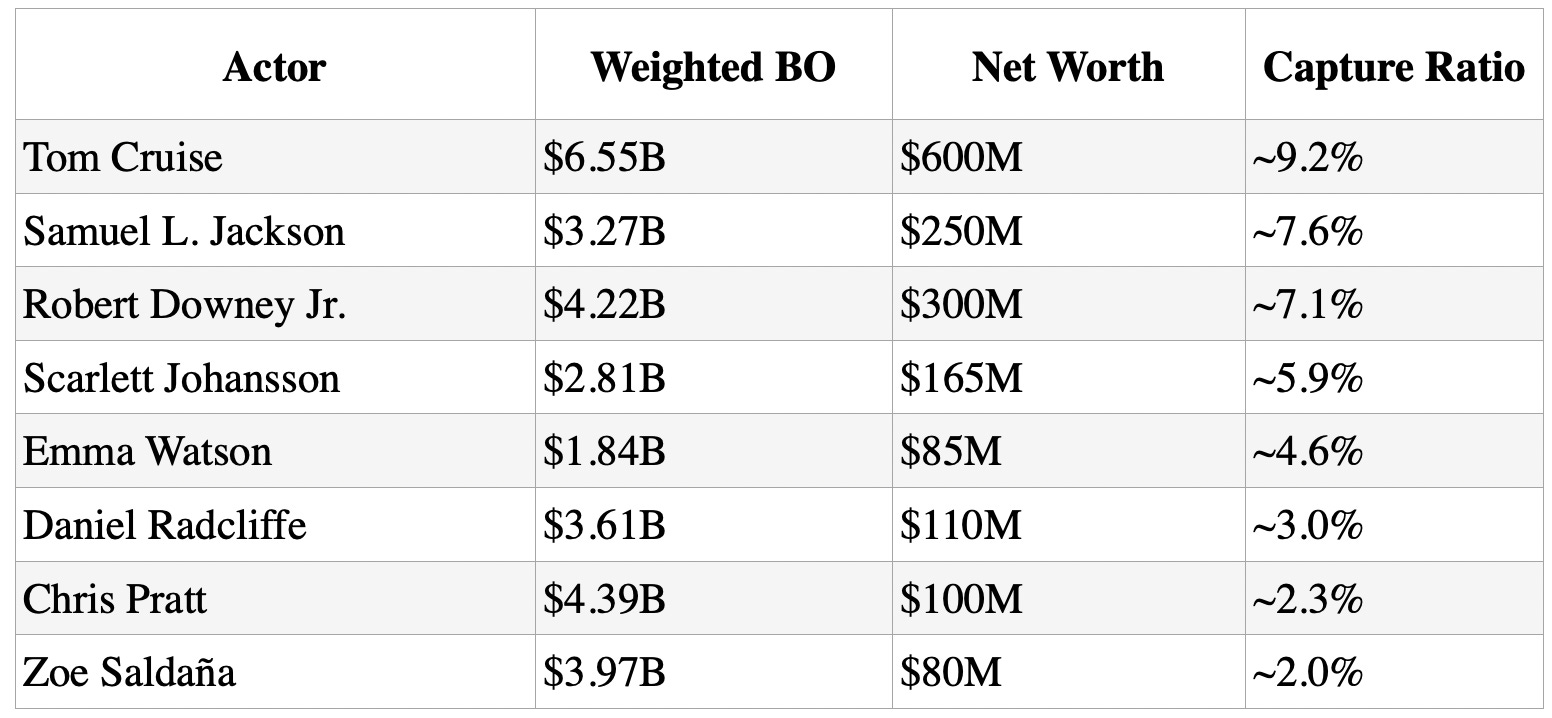
Tom Cruise and Samuel L. Jackson capture the most value relative to their weighted box office. The reason is simple: leverage. Cruise is a producer on the Mission: Impossible franchise, earning $70-100 million per film through backend deals. Jackson negotiated a guaranteed payout for each appearance in the MCU, no matter how brief. In a story that is now legend he reportedly negotiated a nine-picture deal after Marvel used his likeness without permission for a graphic novel.
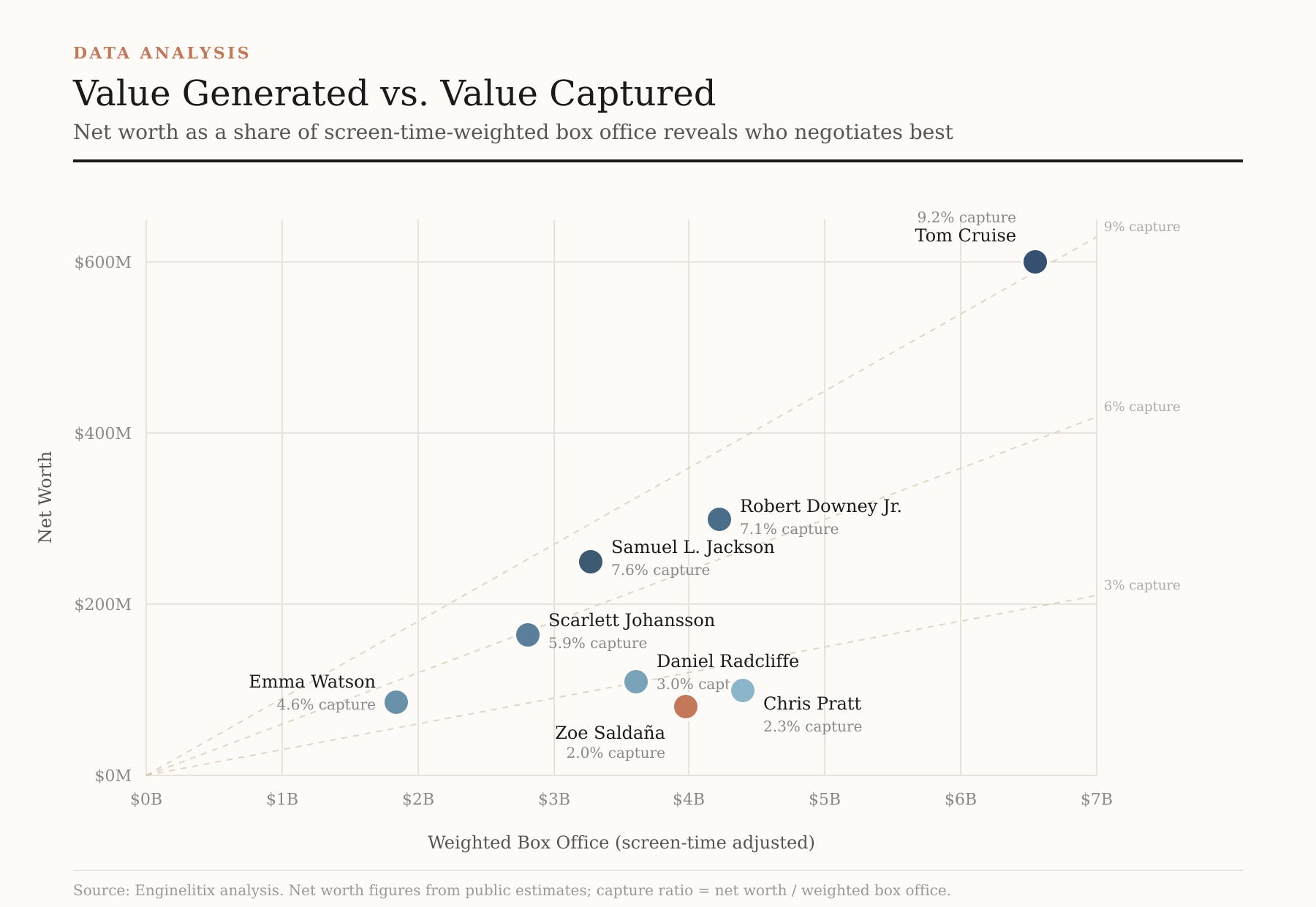
At the other end is the actor who started this story: Zoe Saldaña. Despite appearing in four films that crossed $2 billion each, her net worth is just $80 million - the lowest capture ratio in the sample. She reportedly earned just $100,000 for the first Guardians of the Galaxy where at 31 minutes, she had the second-highest screen time, after Chris Pratt. Meanwhile, Dave Bautista with a similarly important role took $1.4 million. That’s twenty-four times more if you factor in his shorter 18-minute screen presence. Saldaña’s $4 million for the original Avatar captured just 0.1% of it’s gross. Her salaries have grown since, but still represent a minuscule proportion of the box office.
The reasons are unknowable from the outside: early contract timing, negotiating leverage, priorities that aren’t measured in dollars. Whatever the explanation, in our sample she holds the widest gap between box office success and compensation.
And The Award For The Best Metric Goes To…
None of this is to say screen-time-weighted box office is the “correct” measure of an actor’s value. There isn’t one. Every metric is a keyhole view - it captures one angle and obscures others. Raw box office metrics rewards franchise proximity. Lead-role filtering rewards billing negotiation. Screen-time weighting rewards physical presence on screen. None of them capture star power, the ability to greenlight a project, or the cultural resonance that makes audiences care about a character.
What screen-time weighting does capture is something closer to contribution - the portion of a film an actor actually occupied. A fairer way to split the credit.
And when headlines declare someone the “highest-grossing actor of all time,” credit matters.
Caveats and Limitations
Screen time ≠ star power. Box office weighted by screen time measures presence, not draw. An A-list star appearing for 30 minutes in a given movie probably counts more than an unknown actor in a 40-minute role.
Incomplete data. Verified screen time exists for only a fraction of films. The model fills gaps, but estimates aren’t facts. The training data underrepresents actors like Cruise, whose action-heavy filmography differs from the Oscar dramas and MCU ensembles the model learned from. Also, naturally, the list of eight major stars highlighted is illustrative, not exhaustive.
Net worth ≠ film earnings. While net worth is a proxy for film earnings, it’s not a great one. Tom Cruise’s $600 million includes real estate, investments, and decades of non-film income.
Time-Sensitive Data. Please note that figures such as net worth and box office totals may have changed since this article was originally published.
Methodology note: Screen time predictions were generated using a Gradient Boosting model trained on 476 film roles with verified screen time data. Full methodology available for media and industry inquiries.
Thanks for reading. If this article spoke to you, subscribe (for free) to get my new posts.